
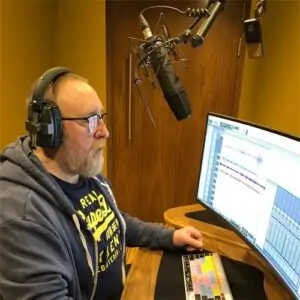
Pierre Maubouché AKA “the French Voice” is a very experienced native male French voice-over artist, from France living in France with his remote recording studio for voice-over thanks to Source-Connect.
He works in French and also, being bilingual, in English with French accent, from very subtle to verrrry strrrrong. So when looking for that perfect continental voice, why settle for fake when you can have the real McCoy of French voice-overs?
Pierre has been cast by the most prestigious advertising agencies and the best production companies to voice the TV commercials, radio spots, podcasts, corporate and promo videos of some of the biggest brands on the planet such as Apple, Renault, Coca Cola, Dolce & Gabbana, Disney, McDonald’s, Xbox, Axe, BP, Dell, Heineken, Canon…
Listen to the full epidote in our Podcast:
Ep1: Source Elements On The Mic with Pierre Maubouché
Interview
Hi, welcome to, On the Mic. Today I’m joined by my good friend Pierre from France
Bonjour. My name is Pierre Maubouche from France and I use Source-Connect for voiceovers, Source-Connect, sexy.
So, Pierre, please can you tell us how do we pronounce your surname?
Hi Mike. Of course, I can. It’s Mau Bouche, Mau Bouche. And it’s Pierre Mike, yeah.
Mike Aiton: Bouche.
Mau Bouche, there you go.
Close, but no dice.
You’ve got it, you’ve got it, that’s exactly that. No, you’re there, you’re there mate, you’re there, that’s exactly that.
Okay. I’ve known Pierre for probably 15 years now. We used to work together when I was head of sound yes Pierre?
It’s more than that mate me. We were working together at Molinar in the 90s
Oh God I forgot that yes.
We were doing those infomercials remember?
Quantum Red Devil, yes.
Yes, quantum, exactly we were doing that. I was at Molinar maybe once a week at that time for those infomercials, yeah.
Goodness me, I forget how old I am.
Mate, so do I, that’s age, right, we’re going geriatric, that’s all you know.
Okay. So to start us off, and to get our listeners familiar with who you are, I’m going to ask you some quick-fire game show questions.
Sure.
You’re not allowed to thank and I want your totally instinctive reaction to each question. Okay, you ready? Fingers on buzzers, you’ll start a round for 10 no conferring? Okay, favorite biscuit?
I don’t eat biscuits, I really don’t
Mac or PC?
Mac.
Starter or pudding?
Oh my God, you like torturing me, mate? Can I have both, please? Both, please.
Analog or digital recording?
Oh, now you’re really are going for it?
You’ve only got three seconds.
Oh, dude. Well, digital because super easy and I need super easy. I’m a voice-over artist, I’m not a sound engineer. So there you go.
Okay. Playback on vinyl or CD?
Vinyl because that reminds me of when I was young.
Favorite audio recording, piece of music, voiceover, whatever?
It’s like, I’ve got twins. So you can’t ask me which one I’d prefer, you see what I mean? It’s the same for that. There’s so much different beautiful music and beautiful artists there, I can’t choose one.
Good answer. Favorite microphone for voice?
For my voice. I work with a U87hooked to an Avalon 737. But it’s not the best for everyone. I was just going to say it really depends on what you’re doing for voiceovers. We don’t want to attract the attention too much on the voice but more on what is said, so U87, for a singer with my voice maybe U47 and 149, things like that.
What’s your DAW of choice when it’s
It’s Pro Tools because that’s what I’ve known all my life, that’s simple.
What’s the most recent music that you bought?
The latest Springsteen?
What’s the most recent software that you bought?
Loopback.
What famous people have you met?
Over the years in the studio, I’ve met so many famous people. I was watching Vikings, the series- and there is- let’s say his name escapes me.
Right, have a senior moment and we’ll move on to the next question.
Go on.
Mountains or beaches for holidays?
I love mountains.
Knave or SSL for recording?
Oh my god, that’s horrible to ask that.
Three seconds
Because they’re both beautiful.
Preferred headphones.
For recording, I like the DT 150, for monitoring, I’ll go for the 77O Pro.
By Dynamics, yeah. Preferred weekend, city break, or countryside?
Countryside.
If you’re recording stereo do record AB or MS?
I don’t even know what that means. I’ll record mono because the only thing I’ll record is my voice so we record mono, don’t we.
Most Hated colloquial phrase?
I’ve got so many, dishes so many things that people say, and you’re like, get an education, you know? Now I’m being pedantic and an old fart, sorry.
What’s the last film that you watched?
Oh, what was it? It was quite a while back- no it was like maybe two weeks ago, and it was some like light entertainment I watch with my boys. They’re nine years old, so, you can imagine.
What’s your favorite plug-in?
You’re talking to a voice-over guy mate, not a sound engineer. I don’t, I don’t use these things.
Okay, so, again, you wouldn’t have a reverb of choice, then?
Bingo.
Which studio would you most like to visit or to be able to use
There is a studio in America, which is entirely treated with diffusion and with massive bits of wood sticking out. I think it’s called the Black Bear studio with massive, massive bits of wood sticking out of the walls, and it’s entirely fitted like that, what you can see, and I’d love to go to that studio, I’d love to hear the sound of it.
Which famous person alive or dead would you most enjoy a night out with?
I’m not very famous people- I don’t know it’d have to be somebody who could drink a hell of a lot and they would enjoy that and smoke cigars and talk crap for the whole night. So I don’t know, maybe Gandhi, Mother Teresa?
Mother Teresa is not famed as a drinker, I don’t think no.
She could become one with me, yeah, somebody like that.
Which concert would you most have liked to have been at?
I think I have been to the one concert I would have hated to miss, which was in the 80s. It was, ‘the sign of the times” tour, Prince tour. And it was just an incredible- I mean, it was magic, it was really magic.
Totally purple.
Yeah, that was incredible. The energy, the scenery, I mean, everything was- the concert was like, it was a magical moment, I saw that when I was in my early 20s. And I still remember it somehow, it’s just incredible.
Alright, let’s talk about you. Obviously, you’re a freelance voice artist, you have your own studio?
I do.
Whereabouts are you based?
My studio is based in the middle of nowhere, exactly which is in France, in the South West of France, between Toulouse and Cass and literally in the middle of nowhere, the first place to buy anything is 10 kilometers, or six miles for you Brits, away from my place. And we’re surrounded by fields and we see the mountain from our house. But I go to London quite often and I’m half and half really to record when I need to travel to record or to Paris.
How would you describe your job to someone who doesn’t know our industry particularly well?
I get paid to talk. No, seriously, I describe it as we tell stories. I’m a storyteller, that’s what I do and that’s how I like to see my job. We don’t read scripts, we tell stories.
How would you describe your job to those who know the industry well?
The same way.
Good answers, very interesting. So let’s go back to your background now. How did you start in your career in the world of acting and voice performance?
Well, I was a DJ, well, it’s quite a big word, beginning of the 80s in pirate radios. Then after a hazy time there, I became an advertising copywriter. I was directing people like me now, then. Then I moved to London for a lady. And-
Surely not?
Surely not. And then, I didn’t know anyone there besides her and her friends and all that. So I did whatever I could, translations or whatever. And I was putting sales up in my flat and I heard a radio commercial where two English guys were speaking in English with a French accent that was really crap. And I had a light bulb moment and I thought I can do that better. And because I was connected with the studio and commercials and all that because of my previous job as a copywriter. I thought I can do that, like (?Kat Winter) would say.
I recorded a demo in English with a French accent, which I sent to agents, and they told me you need a demo in French because London is like the localization place in Europe and we have a lot of work in French. So I recorded a demo in French and then I started to work. And although that lady and I didn’t work out, I stayed in London, and I stayed there full time for 15 years and the rest is history.
So you haven’t had any particular formal training, per se, in terms of acting?
No, nothing.
But you’ve kind of been to the university of learned on the fly, vibing, and copywriting.
Exactly. Being a copywriter and that still to this day helped me a lot, because I know what it is to be on the other side of the mic and directing people and it really helps to have this perspective on our job.
What’s your pet hate when you’re being directed by someone else? What most bothers you? I’ve heard some voice artists say it’s when they go, “no what I want is”, and then they do a really bad performance. Have you ever heard of the famous William Shatner?
Yes, yes. Well, I’m going to answer with something I did myself and I learned my lesson there. When I was a copywriter, I was directing that guy, a very, very good voice-over and I told him, he was not interpreting the script the way I wanted. So I told him how I wanted it to be said, but by actually saying the scripts and trying badly at the time, I was not a voice-over then. And he told me, “Pierre two things. You’re a copywriter but I’m a voice-over and that’s me who is behind the mic right now. So please, give me directions, tell me what you want as a result but don’t try to-“
Mike Aiton: Show me?
“Don’t try to tell me how I should say things, it’s my job and I do it better than you.” And I really felt insulted at the time and I really felt like going in the booth and slapping him in the face. I was a bit less quiet than I am now being young and all that. I didn’t but I really felt, you arsehole, how dare you talk to me like that, I’m kind of very important. And then at the end of the day, I really felt that that was wrong. And then I thought no, I was the one who was out of line, and that day that was a great lesson I learned.
I hate that equally when people do that to me now. Like I think all voice-over artists we’re there to be directed. I think of myself and voice-over artists as instruments or people who play in an orchestra, musicians in an orchestra, we’re there to follow-
To follow but interpret, yes.
Different things, the director and the others, the other elements could be like the pictures and the M&E’s and all that. There are people to direct us, we’re there to give them what they want with the added value of bringing magic if we can to their script. But their job is not to tell us how, intonation and all that because they can’t, because it’s not their job.
What do you most enjoy in your job?
It’s so varied, where the variety of work we get to do, that is brilliant. Like I said before, I love to tell stories, I always loved that. And now I’m paid for it, so that’s amazing. But telling a story can be three words at the end of a TV commercial or it can be an audiobook.
Mike Aiton: Yes.
And it’s different ways to tell stories, different techniques, and the rest of it. But at the end of the day, it’s telling stories.
So given that as a sort of premise, what do you think you would like to do more of and what would you like to do less off in your career?
That’s a good question. I’d like to do more TV commercials because they pay handsomely.
We’ve all got to eat
We’ve all got to eat, exactly. No, I think I’ve got the right balance really. I’m a happy Chappie, I record a fair amount of TV commercials so, I can’t complain. I do audiobooks which I love doing. And I do-
And you do games as well, don’t you?
I do games, yeah. I record games and I direct games, I just finished directing the French version of Riders Republic at Ubisoft, comes out in one month’s time, end of October.
That’s a big-time, nice gig?
And that was brilliant, an amazing gig, I loved it. Great team, and amazing voice-over people, amazing production people.
Did you record remotely for that? Or did you?
We recorded at Ubisoft Montpellier, so all the voice-over artists come to Ubisoft and I was there as well to direct.
You make Montpellier sound so much alluring the way you say [inaudible 17:53] say Montpellier
Montpellier. But that I’d like to do more of, directing games and I’ve got something else big I can’t talk about it. But it’s-
Mike Aiton: Sure
It’s ginormous, coming out.
As the actress said (?the bishop)
That one, absolutely and but directing, I love that, I really, really love that. And the way I see it is I’m serving the voice-over artists who serve the project, and I’m there to serve them. I’m not there to be the boss of the session or to boss people around or.
Are you actually doing now what you thought you wanted to do? To give you an example, when I joined the BBC, at the start of my career, I thought I wanted to be a music mixer and I joined the BBC to be able to mix, the Old Grey Whistle Test. Well, they canned the program, almost the first year that I joined. Luckily they started later with Jools but I discovered actually that I love dialogue, and I love television, and film, and all these sorts of things. And actually, music is also something I love, but I discovered it wasn’t my primary focus, and I ended up doing, not what I thought I wanted to do. And I luckily discovered something else. So that’s my question is, are you doing what you thought you wanted to do?
You know, it’s really funny as you said, how life can take you places you didn’t expect. I never thought when I moved to London, I was going to become a voice-over artist. All of a sudden I had this epiphany and then I recorded those demos. I met a guy, Peter Kiley who was a sound engineer we were at his studio at the time in London who helped me a lot. Then I met brilliant agents who accepted to represent me and it went that way. And I started quite quickly after a few months to have a certain success in that job, and I really enjoyed it. But I could have had an epiphany about I don’t know, something else, it’s funny, isn’t it?
Mike Aiton: Yeah.
But anyway where I am now, I really love it. I mean, now I teach, I direct workshops to people who want to pursue a voice-over career or to advance their career.
Along that vein, what sort of personal qualities do you think best suit your job?
For me, it’s listening. It’s funny, isn’t it? Because we work with our vocal cords, but I think- I have a blog which is in French, I think it’s the first article I wrote in my blog, which is the most important organ, in our job as voice-overs are the ears. We need to listen, we need to listen to what people want.
Very interesting because there’s a jazz guitarist Pat Metheny, and he said, the best improvisers are the best listeners.
That’s interesting, it’s along those lines I feel exactly the same. We need to listen to what people want, the client, and also listen to what the audience wants. And I think that now people want something more human, more real, as opposed to, like either clinical reads for cooperator or very salesy stuff for commercials. People just want normal people to talk to them.
A sense of honesty?
We relate more to normal people, yeah. If you’ve got a car salesman, who goes, oh, yeah, come in, buy this car, because it’s great, you’re going to tell him to sodd off? If people tell you well, this car does that, it’s got that, he talks to you normally, then you’re going to be more inclined to talk with them less and to connect with them.
Thinking about how you’ve learned on the job, so to speak, and having learned from being a copywriter. And obviously, now you’re involved in passing some of your knowledge and experience on with teaching other people, with clinics and things. How do you think the educational process is in the industry for up-and-coming talent?
You’ve touched on a very interesting point. Well, I’m going to be brutal-
Please be frank.
Yeah, I think most of the coaching that we see, which is offered online is terrible, it’s crap. But then again, I think that if people choose coaches like that, it is their own fault. I mean, now we’ve got the internet, we’ve got Google and the rest and it’s very easy to Google the name of someone. If someone pretends to be a multi-million or multi-hundred thousand or whatever, voice-over and that has a lot of success and then it’s trying to sell coaching, or, classes or what have you, workshops based on that.
Well, surely they have a website, where they put all their TV commercials and great successes on it or a YouTube channel or something. If somebody pretends to be that, and they have nothing to show for they’re lying because you’re going to be able to-
Yes there’s a sense of sales and fraud.
Exactly, there’s a lot of scammy stuff, and the same for voice-over portals, there’s a lot of scammy stuff out there. But among that, there are amazing coaches, brilliant people. There are very good websites that present voice-overs. So it’s a question of really doing your due diligence in finding who is a scammer, who are the hustlers, and who are the real people. If you really want to find out, you’re going to find out it’s easy, it’s Google, you know,
In a way learning in the industry has changed and there’s more learning available but a lot of it is of dubious quality or dubious origin and you have to search out the wheat from the chaff. That’s what you’re saying?
It’s ironic isn’t it, it’s ironic, it’s exactly that. Before, when I started, I was a copywriter, so I was kind of used to different approaches to descript and all that. But people who just started, maybe they were actors or I don’t know, or they did acting schools or something, or they just had the knack for it, I don’t know. But we just had to listen, and kind of wing it. And now there are, much more resources available but when I see people who are scammers, who are hustlers, that have a certain success in certain networks, and certain voice-over networks, then, I think, well, good on them. The people who follow their coaching or their workshops should Google them. Why don’t they?
What nuggets of knowledge did you think you learned early on in your career that have stayed with you as a mantra?
Well, first of all, the story I told earlier, that, stay at your place, do your job, but don’t try to do what other people do better than you and tell stories, tell stories. Even if it’s- one of the shortest commercials I ever did was the Dolce and Gabbana Light Blue commercial, literally it’s, Dolce and Gabbana, Light Blue, five words, and you still tell a story. There’s a beginning, a development in the story, and an ending to it. And an audiobook of 300 pages, there is a story as well, everything is stories.
And it’s just some things take longer to get there.
Exactly. This is what I tell people, tell stories, reading out loud is not being a voice-over. I mean, the text-to-speech stuff does it really, really well now, really well. They read out loud and they do that fantastically well.
But it doesn’t tell a story, it has no intonation?
They don’t tell stories. And this is the difference between reading out loud and talking to people.
I remember when I think it was Nicky Horn who was our Capital Radio DJ in the ’80s. He used to have a photograph behind the microphone and he always used to talk to a photograph of his family. And he said in that way, by having a photograph behind, I feel like I’m conversing with my family by looking at them.
That’s a fabulous idea.
And it enables a different part of my personality to come across.
That’s funny you say that? Do you know why? Because when I was directing, Riders Republic at Ubisoft, some people there is a mic and they can’t help talking to the mic. And I tell them, it’s a gadget and sometimes it’s a few 1000 quid gadget, but it’s still something that transforms what you say into a digital signal, that’s all.
It’s just a transducer.
Exactly, it’s a gadget.
And nothing more?
Nothing more, don’t talk to the microphone, talk to the people you’re talking to. And sometimes it’s difficult to do because the mic is there. So, there was a cutout of a superhero, which was like real size in a room, adjacent to the studio there, the studio of Ubisoft, we were recording in. So I said, hang on, I went to get the cutout, I put it in the booth, it was a big, big booth. I put it in the booth and I said, talk to this guy, talk to this guy. And that changed completely the approach to the script. And it’s exactly that, you talk to people, just like we’re having a convo right now, we’re talking to each other.
It’s not because that there are words that are written on a script that we should like say them differently. We read with our eyes, reading is, is a process of decoding characters, symbols that are letters, but when we speak we talk to people, we tell stories.
It’s quite interesting because I’ve found that certainly across different nations, Americans, write, how they speak.
That’s true.
In Britain, English is formally very different to how spoken English is?
Very true yeah.
Is the same true in French?
French, generally speaking, is a much more formal language than English. People at work call each other still- I mean, it is changing, but still by their family name. When people leave a message on their voicemail, they say their family name before their first name. Like, for instance, [speaks in French] and it’s like, nobody speaks like that. When you introduce yourself to somebody, you don’t say, Maubouche Pierre, you say Pierre Maubouche right?
I would go, if I left a message on your machine, it would go, hi, Pierre, how are you? Give us a callback? I would never say, Aiton Michael here.
Absolutely. So French is a much more formal language. So to make it more humane and more like you’re talking to people it’s a different approach to the script than in English.
Let’s now take a slightly different turn. Let’s take a technical tactical turn.
Tell me
Let’s talk through your booth and your setup and your experience of working at home. Would you like to talk us through what sort of computer do you have?
I work with an iMac which is in the gallery. I’ve got one of those Samsung curved, massive gigantic screens where I can put, my Pro Tools and my script.
The sort of screen that makes teenage boys very excited?
Yeah, that one, I was excited about something different when I was a teenage boy.
Mike Aiton: Stop it.
But well, those didn’t exist, you know, we had to find something else to be excited about, I guess. So yeah, I’ve got one of those screens.
What audio interface do you use?
SSL two-plus, which is just incredible value for money. SSL please send me a check, thank you. It’s staggeringly good value for money. I’m going through an AvalonVG 737 SP.
That’s your mic cam?
That’s my mic cam obviously.
And is it your compressor as well?
I don’t use an EQR compressor, I leave it to guys like you who know what they’re doing with it, I’m a voice-over, I’m not a sound engineer. So I let all that slip on the Avalon. But to be honest, if I didn’t have the 737, I wouldn’t miss it that much because the preamp in that tiny SSL interface is so good, it really is.
Gives it a run for its money?
It really does and the Avalon costs a fortune. I mean, now I’ve got it, I use it and you can give it a bit more butter and stuff like that with the Avalon on the gain and things like that. You don’t have this option with the SSL but I mean, it’s amazing, it really is an amazing piece of kit.
And you’re listening through DT 150s are you? The Bayers?
Yes, I am, yeah. When I playback, when I want critical listening, I put the DT 770 which are a bit brighter, but that’s why I don’t wear them to record because they’re a bit too bright for my ears. But also because for 30 years I’ve been used to- well 27 years, I’ve been used to the DT 150.
Yes, it’s the studio staple?
That’s why you’re used to I guess, yeah.
And it’s very good with spill. What other microphones apart from your U87, do you tend to like using?
Well the U 87 is my staple because it works very well with my signature voice, with what I do for commercials which is more, softer reads and I don’t do hard sale and stuff like that. For promos, like punchy stuff I’ve got a 416 which is really fast mic, it’s very punchy.
Yeah 416 can be quite intolerant of bad acoustics.
So is the U 87
Yeah because the 416 can be especially punishing where there are reflections around because it uses an interference tube.
Absolutely.
So if you’ve got too much glass that’s not at the right angle and all that sort of thing, a 416 in a bad room sounds appalling.
No, absolutely, absolutely. But so is the U87, a lot of people who start, classic question, which mic should I get? And I tell them if their environment is not perfect even a 103, I don’t think that’s a good idea. I think that they should get a road NT one, which is much more forgiving. And it’s an OK marquee and also, the investment is much less.
So yeah, I’ve got that. I’ve got a vintage mic, which I love, which is a CAD Equitek 100. So not the ES one, which is the current one-
Is that the square one?
Yeah, it’s kind of rectangular with a gold mesh on it, it really looks vintage. You can get one on eBay for about, I don’t know, $300 or something like that. And the sound of it is amazing. I mean, if or when my UHD 70 is going to go for maintenance, I use that, it’s that good. It’s that good. It’s beautiful. On voices like mine at least, it’s beautiful. It’s got two, nine-volt batteries in it.
Great for polarization.
Yeah, no, it’s a great mic. But the E 100- and the way to recognize which one is the best one, the one I’m talking about has a round logo on it not an oval logo, which was version two of it.
It’s not the oval,
Not the oval, never no, the round logo. Equitek E 100, it’s surprisingly amazing for $300 or whatever.
Tell us about your booth then.
Well, there was a studio I loved in London, which was music four. And I loved the sound of it. It was a matte sound but it was very live and on the floor, it was wood flooring. And so I asked boss whom I knew, how he achieved that acoustic, that sound? And he said, well, I don’t know, it’s just the room and we did it like that. And so I tried to-
A happy accident effectively?
Exactly, yeah. And I tried- there was a lot of absorption, diffusion, and reflection through the floorboards. And I tried to emulate that in my booth. And well I don’t know if I emulated that, but I’m really happy with the sound in my booth. I mean, either I was going to hire like, people who build studios, and that costs an absolute fortune, and quite rightly so because it’s a lot of knowledge and time, it’s very, very time-consuming. Or learning. And I went through the learning way so I had to learn to apply the acoustics.
So I’m not an acoustician, I’m not a sound engineer, but I learned acoustics applied to a recording studio, how to build it. Not a great booth for that, so I basically mimicked what they were saying.
Do you have air conditioning in your booth?
Yes, yes I do. It’s a very, very slow hedge vac with very, very large pipes so that there’s no whistle.
So it’s what’s called a slow slew, isn’t it? A slew range?
Exactly.
So large volumes of air moving very slowly?
There you go absolutely.
Next question, this is really fascinating me at the moment. Studio chairs. Studio chairs are the buzz thing amongst audio engineers and sitting is the new smoking. You know, everyone’s trying to stand?
I like that, I’ve never heard that before sitting?
I’m going outside for a sit, we should be looking after our backs. Do you have a particular chair or?
Oh, god yeah. For years, I had a chair like kind of a (?Scandi) design, really, really nice design. But after one hour, my bum would hurt and then my back and, when you sit for long hours in your studio- I mean, when you do a commercial, it’s one hour, and then that’s your day or maybe you know another session later or whatever, then it’s alright. But when you do like long-form-
When you’re recording a book, it’s a long day yeah.
Or e-learning or stuff like that then you’re there for hours. So I invested, I mean, it’s a small fortune but it’s a Herman Miller Aeron chair.
Aeron the classic, I believe so.
It’s just, it’s made of mesh. I bought one of those things to rest your head on top of it in the same style just so that it looks nice. And so you know, every hour or so I just relax or rest my head and it makes an enormous difference. I think they should send me a check as well.
You get less tired because of it?
I can sit see eight hours in my chair consecutive well, besides, going for a pee or having a sore knee or a tea or something. But yeah, I can sit for long, long hours in that chair and my back doesn’t hurt, my bum doesn’t hurt. So yeah, it cost a small fortune
I’m very relieved to hear.
Absolutely, it’s important. I think they should pay me really for that, commercial, but I recommend that to everybody. It cost a small fortune but then again-
Mike Aiton: Aeron
Aeron. But you can buy some on eBay for not a lot of money, secondhand and it’s worth every penny.
Let’s take another turn now and think about how, in the last two years with the changing environment due to the global pandemic, how has that affected your work?
I had a lot more work, a lot more- maybe not a lot. I mean, it’s how I make my living so luckily, I worked quite a lot. But I did have more work.
Mike Aiton: Before?
No, no, no, after. Because I’ve got my studio, it’s a real studio, it’s not a 10 quid Dixon mic in the cupboard. And-
You spoiled my illusion that you’re sitting there with a blanket on your head
And, all of a sudden, during the lockdown in 2020, the studios closed down, there were no facilities to record, but still, productions needed to be done. So all of us in the know, people invented a recording studio in their place, and you look at pictures, and you’re like, mate just don’t show the pictures, at least.
There’s quite a lot of chaff around the wheat?
Yeah, a lot of it. So, I guess because I already had a real studio, this is one in at the moment, then I had more work because of that and then when business started to reopen, and productions were waiting in line and stuff like that well, I think everybody got to be busier.
So what percentage of your work would you say is remote compared to appearing on-site?
I don’t know, it’s difficult to say, quite a lot.
How do you find remote working?
That’s a good question. I like how easy it is because my studio is in my building, my commute is about 17 seconds, so that’s brilliant.
So you (?bought the mine?) So you’ve obviously got a bigger car than me?
We bought an old farm in the middle of nowhere, thinking that was a very romantic idea except that we will be living in a building site for the rest of our life. But it’s a very big building site, it’s the size of a church, everywhere that there are building sites, everywhere in the house.
Do you like the phrase the road to perfection is under construction?
Yeah, and it will be until I die in my house. But it is- I like-
Voice-over artists never die, they go for another take.
I don’t know, I like how easy it is. On the other end. and now with Source-Connect, which makes our lives so much easier. And the checkout I’ll give you in the address at the end. Just as if I was in the booth next door. What I miss is, missing my mates, sound engineers going to the pub at the end of the day, having a chinwag, and the rest of it. That part I really miss when I don’t go to studios, the social interaction, face to face.
That’s a strange thing because, at Source Elements, we have a philosophy that when we’re apart, making things together, helps us stay connected as human beings and creates a bond sort of thing. But unfortunately, it’s very hard to have a beer moment and it takes a lot of work to be able to sort of generate that?
Yeah. And at the moment, it’s much more difficult, obviously. So it’s great to have these tools available to work with, it’s brilliant.
This is the commercial bit now, which Source Elements products do you actually use in your workflow?
And here’s for the commercial bit. Source-Connect, I use it a few times a week, I guess, at least two, three times a week, something like that, as soon as I work with a remote studio, Source-Connect. And Zoom as well, when I need to work to pictures. I heard that Source Elements has a video solution, now?
We do which I would be delighted to demonstrate to you.
I’d love to have a look. At the moment, I’ve got to use two solutions, when I work to picture and when they want to record me remotely, I always record local anyway as a backup. But when they want to record remote, then, I work through Zoom with Source-Connect running as well, which is fine, it’s no problem. But if there was one shot integrated solution that people could get, especially if it’s cheaper than Zoom.
What advice would you pass on to someone who’s is trying a remote workflow for the first time?
That’s a good question. I would tell them first before you focus on the gear, focus on the acoustics, not only the acoustics but the sound insulation, especially if you live in a city or noisy area or something. And that’s difficult because you need mass and acoustics. Make sure that you treat your room properly so that you’ve got a mat sound, but not those sounds and that’s nice to listen to and then gear, bit by bit. A lot of people I know, work with an NT1. It’s not a U 87 but it’s not crap either. I really think that and I would tell them to like get coaching, read and read stuff about the trade, and to educate themselves.
I think that the interpretation, the way we tell stories, is 1000 times- if somebody tells a story beautifully, in a 10 quid Dixon mic, it’ll always be better than somebody who is reading out loud in a U87.
Yes. I understand what you’re saying content over-
Oh, god yeah.
It’s performance, performance, performance?
Oh, absolutely, yeah, absolutely.
And in terms of the psychology of remote working, have you’ve got any advice you can pass on to other people who are newer at it?
Yeah. Just don’t become like this character in The Shining because you will end up killing people because he does, that Jack Nicholson character in The Shining . Seriously, you can obsess over work and stuff- all your admin work, don’t do it on your studio computer, do it somewhere where you see the daylight, where the sound is natural in a booth or sound is not-
I find the same, one of my hobbies is playing the guitar. I don’t like to play the guitar in my studio because it feels like it’s a busman’s holiday, I’m at work and I like to play the guitar sitting on the sofa in my lap.
Absolutely, absolutely.
Because it’s away from my faders and my microphones.
Completely. And also, when you’re recording in a booth the result is beautiful if this is a good sound and stuff, but the booth is not a natural acoustic environment. And if you stay in there too long, then it’s not good for you. We’re animals, our brain is trained to detect sounds and it’s not a natural environment. And also, like, if you stay in your booth all the time you can- there’s something slightly compulsive and obsessive about it. So yeah, I would say if you do your admin, we all have to do it, when you do your admin, just go take a laptop or chip, whatever, doesn’t matter, Mac Book Pro or whatever you fancy.
And do it on the lie low in the pool whilst having gin and tonic.
Yeah, yeah exactly.
Make it a pleasure.
Do it in your jet, or in your yacht, just don’t- you know what I mean?
Go to buy an Aston Martin for peace and quiet.
Yeah, exactly. Don’t stay in your booth all the time, and also take breaks. Take breaks, because it’s your vocal cords, they’re muscles. And, it’s a good thing to train them so that you can work with them longer without straining them and stuff but also just take breaks. People, masons and carpenters, and people who work with their body they take a break
Yes, rest is important.
Yeah, absolutely, absolutely. But also mentally, don’t obsess over it.
Let’s think of you as an individual within the industry now, how would you like to change the industry? And how would you change it if you could?
That’s a super good question, that’s really interesting. That’s very interesting because at the moment there are debates about peer-to-peer websites, castings done, where people cast by rate and not by talent. And what they call the top tier like TV commercials and stuff like that, they do cast by talent but more and more for corporates, well sometimes, they cast by rate, what’s your rate? And it’s like- much less so in the UK, where- what, really now pisses me off is when people contact you and they say, “oh, I’ve seen your portfolio and oh, that’s very impressive and I really like what you do and oh, I’ve got a corporate video, would you do it for 50 quid?”
We sound engineers have exactly the same problem.
I’m sure.
Where I’ve got a short film, would you mix it for me? And you kind of go, yeah. And some have rung me out once on a bank holiday weekend.
I know what you’re going to say, exposure.
Yeah, exposure dollars.
I’m going to pay my rent with exposure and feed my kids with exposure, yeah of course.
Yeah. This person rang up on a bank holiday and said- just before a bank holiday, it was the Easter weekend, and said, I’ve got a short film, and I need it mixed by Tuesday. I said, “you realize it’s a bank holiday weekend.” Yeah. So I said, “okay, well, don’t worry we can throw people at it. So what’s your budget, then?” “No, there is no budget.” “Okay, so, there is no limit on the budget, brilliant.” And they went, “No, there is no budget.”
There is no money.
So I said, “hang on a minute are you expecting me at short notice to work and cancel my weekend with my family on short notice, of course for free for you? ” And they went “yeah.” So I said, “I earn my living doing this and I like to think I’m quite good at it. And I’ve been earning my living at this for 30 years.”
So that means that you are good at it otherwise you wouldn’t have stayed in the industry.
Absolutely, yeah. So I will politely decline your offer, Thank you very much. And they said, “you may not want to but do you know anyone who will?” And they said, “what about students?” And I said, “no, it is Easter, they’ve all got their dissertations in or whatever, or beavering away as hard as they can for their finals.” And, quite frankly, anyone you want at short notice it’s the triangle of good fast and cheap, pick two,
You’ve been much more well behaved than I would have been right.
So I turned around and I say to them, “what you’re asking me to do is provide a bank loan for the sound for your film.” I said, “do you ask your bank manager to mix movies?” They look at me and go, “no.” So I said, “don’t ask me to loan you money to mix your films because I do it for my living.”
It’s exactly what it is.
Here we go last question then. What would you like as your voice-over epitaph?
My God, I never thought about that dude, I don’t know.
Your start for 10?
I don’t know, once more with feeling.
Yes, love it.
Which is a book that my friend, Victoria Curran, wrote a long, long time ago about the porn industry, once more with feeling, I don’t know.
What a perfect night
Voice-over Pierre Maubouché
Find more stories about other voice-over: News & Stories
How voice-overs can build a remote recording studio at home: Source-Connect
Mau Bouche, there you go.
Close, but no dice.
Oh God I forgot that yes.
We were doing those infomercials remember?
Quantum Red Devil, yes.
Goodness me, I forget how old I am.
Sure.
I don’t eat biscuits, I really don’t
Mac or PC?
Mac.
Starter or pudding?
Analog or digital recording?
Oh, now you’re really are going for it?
You’ve only got three seconds.
Okay. Playback on vinyl or CD?
Vinyl because that reminds me of when I was young.
Good answer. Favorite microphone for voice?
What’s your DAW of choice when it’s
What’s the most recent music that you bought?
The latest Springsteen?
What’s the most recent software that you bought?
Loopback.
What famous people have you met?
Go on.
Mountains or beaches for holidays?
I love mountains.
Knave or SSL for recording?
Oh my god, that’s horrible to ask that.
Three seconds
Because they’re both beautiful.
Preferred headphones.
Countryside.
If you’re recording stereo do record AB or MS?
Most Hated colloquial phrase?
What’s the last film that you watched?
What’s your favorite plug-in?
Okay, so, again, you wouldn’t have a reverb of choice, then?
Bingo.
Mother Teresa is not famed as a drinker, I don’t think no.
She could become one with me, yeah, somebody like that.
Which concert would you most have liked to have been at?
Totally purple.
I do.
Whereabouts are you based?
The same way.
Surely not?
No, nothing.
To follow but interpret, yes.
What do you most enjoy in your job?
We’ve all got to eat
And you do games as well, don’t you?
That’s a big-time, nice gig?
Did you record remotely for that? Or did you?
It’s ginormous, coming out.
As the actress said (?the bishop)
A sense of honesty?
Please be frank.
Yes there’s a sense of sales and fraud.
And it’s just some things take longer to get there.
But it doesn’t tell a story, it has no intonation?
That’s a fabulous idea.
It’s just a transducer.
Exactly, it’s a gadget.
And nothing more?
That’s true.
Very true yeah.
Is the same true in French?
Tell me
The sort of screen that makes teenage boys very excited?
What audio interface do you use?
That’s your mic cam?
That’s my mic cam obviously.
And is it your compressor as well?
Gives it a run for its money?
And you’re listening through DT 150s are you? The Bayers?
Yes, it’s the studio staple?
That’s why you’re used to I guess, yeah.
Yeah 416 can be quite intolerant of bad acoustics.
So is the U 87
Absolutely.
Is that the square one?
Great for polarization.
It’s not the oval,
Tell us about your booth then.
A happy accident effectively?
Do you have air conditioning in your booth?
So it’s what’s called a slow slew, isn’t it? A slew range?
Exactly.
So large volumes of air moving very slowly?
There you go absolutely.
I like that, I’ve never heard that before sitting?
When you’re recording a book, it’s a long day yeah.
Aeron the classic, I believe so.
You get less tired because of it?
I’m very relieved to hear.
There’s quite a lot of chaff around the wheat?
I don’t know, it’s difficult to say, quite a lot.
How do you find remote working?
Voice-over artists never die, they go for another take.
We do which I would be delighted to demonstrate to you.
Yes. I understand what you’re saying content over-
Oh, god yeah.
It’s performance, performance, performance?
Oh, absolutely, yeah, absolutely.
Absolutely, absolutely.
Because it’s away from my faders and my microphones.
Yeah, yeah exactly.
Make it a pleasure.
Go to buy an Aston Martin for peace and quiet.
Yes, rest is important.
We sound engineers have exactly the same problem.
I’m sure.
I know what you’re going to say, exposure.
Yeah, exposure dollars.
There is no money.
It’s exactly what it is.
My God, I never thought about that dude, I don’t know.
Your start for 10?
I don’t know, once more with feeling.
Yes, love it.
What a perfect night